
Training  for Counselors


Workshops, courses and seminars, run by SPPCSH

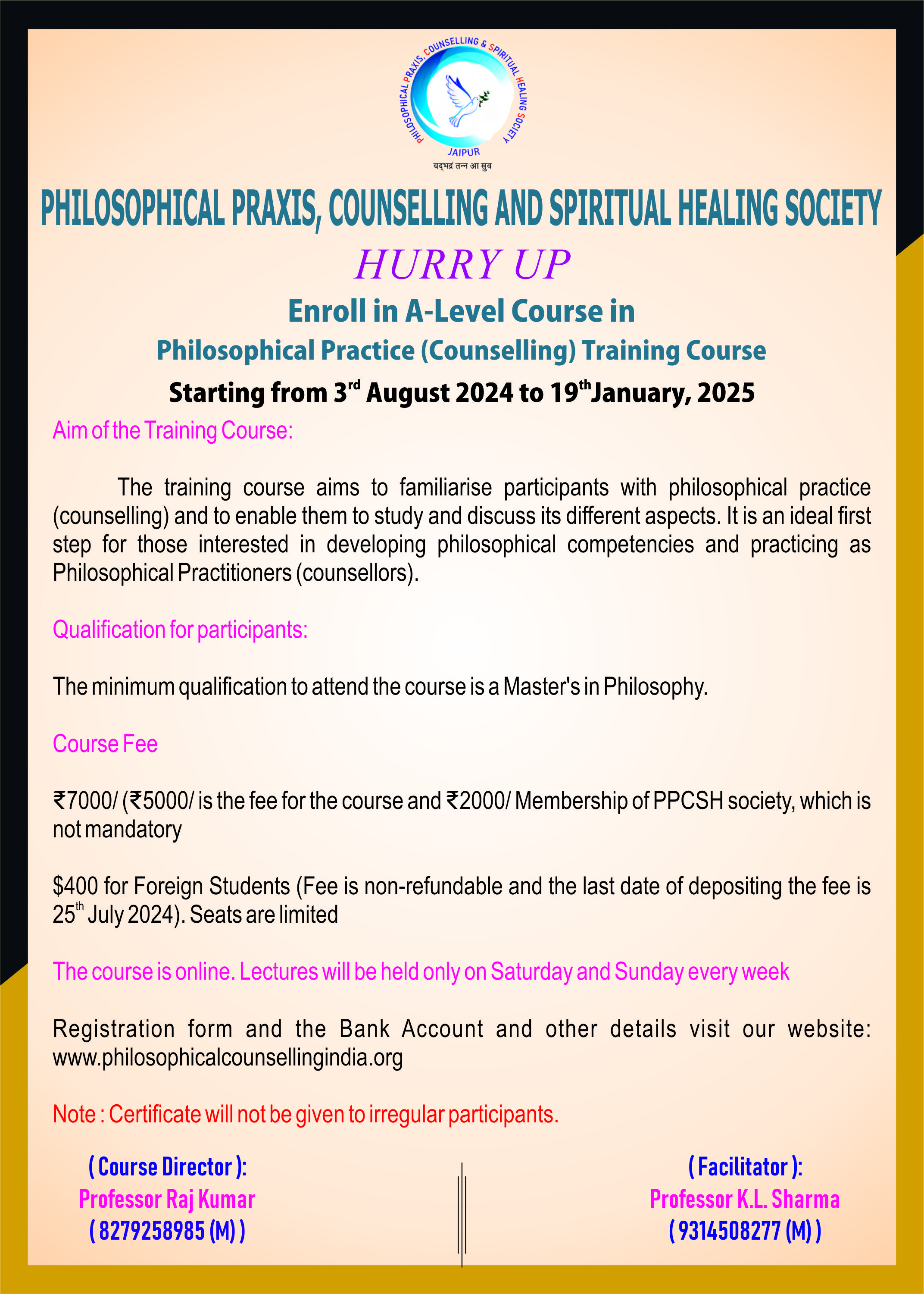
Note : Those Compeleting the course will be certified philosopical counselling and spiritual Healer. The certificate will be awarded to this effect.

Aims of the workshop:

The workshop aims to familiarise delegates with philosophical counselling and to enable them to study and discuss its different aspects of it. It is an ideal first step for those interested in going on to train as philosophical counsellors.

In our work and private lives we are faced by many situations that call out for an ethical response. For example we might be faced with trying to decide the best way to look after an elderly relative, or what advice to give to a friend who is seriously ill, or how best to deal with some one at work who we think is not doing their job properly, these are some of the issues that can be difficult to resolve satisfactorily.

These workshops, courses and seminars will enable you to understand what makes ethical decisions difficult and how to move towards making wiser ethical decisions. In these courses you will be guided to make wiser ethical decisions about particular cases, and learn a procedure (called 'PROGRESS') that you can apply to many other situations.

These workshops are both for people who want help in how to deal wisely with ethical issues that they themselves face and for people whose job involves helping others (counsellors, teachers, social workers, managers, doctors and nurses etc.) to make ethical decisions and solving other issues.

YOU DO NOT NEED TO BE FACING AN ETHICAL PROBLEM TO BENEFIT.

PHILOSIPHICAL COUNSELLING COURSE

  1. What is philosophical counselling?
  2. PHILOSOPHICAL SELF-COUNSELLING
  3. Socratic Dialogue
  4. Maslow Seminar
  5. Ethical decision making
  6. Philosophical counselling techniques:
    (a) Client- centered psychotherapy
    (b) Existential psychotherapy,
    (c) REBT and
    (d) Logotherapy
  7. Ethical dilemmas in the helping professions
  8. Happiness
  9. Spirituality and Healing
  10. Meditation

The workshop is intended for any one interested applying philosophy to everyday issues. No previous knowledge of philosophical counselling is required.

1. What is philosophical counselling?

Philosophical counselling is an approach to counselling that uses philosophical insights and techniques to help you think about your life. Your problems are not seen as illness to be cured. Instead your counsellor will engage with you in a dialogue whose aim is to help you think more clearly and deeply about your issues.

Course topics

What is philosophical counseling?
How does it differ from other forms of counselling?
What sort of people or problems does it best deal with?
What is philosophical about philosophical counselling?
What further steps do I need to take to train as a philosophical counsellor?

2. PHILOSOPHICAL SELF-COUNSELLING

A. What is the course about?
Philosophical counselling is an innovative type of counselling which uses philosophical skills and insights to help people think about their lives. A significant number of these skills can be applied on one's own, acting as one's own counsellor. This course is a practical introduction in how to do this. The sort of issues that this course can help with includes career changes, lifestyle issues, dilemmas and confusion about direction in life. Participants should be willing to work on some of these issues in small groups and on their own on the day. The course is not suited to deal with deeper emotional issues such as anxiety or depression.

By the end of the course you can expect to have gained

  • a basic knowledge of philosophical counselling and self counselling
  • an opportunity to apply some techniques from philosophical counselling to some of your issues on the day
  • the capacity to use the techniques which can help with decision-making, personal values clarification and conceptual confusion for yourself in the future.

The course will be partly lecture and seminar based and partly experiential As well as taking the course for its own sake it can also serve as an introduction in to philosophical counselling for those interested in taking it further either as client or counsellor.

3. MASLOW SEMINAR

What is the course about?
The course is about Abraham Maslow, the founder of Humanistic Psychology. He is associated with the hierarchy of needs, self-actualisation and "Theory Z" in management. The man and his work will be discussed in the seminar and we will try to assess his value and applications of his ideas in the fields of psychology, counselling and management.

What level is the course?
Introductory. Some familiarity with Maslow's work would be helpful. But is not at all essential.

What can you expect to achieve?
By the end of the course you can expect to have

  • a better knowledge of the life and works of Maslow
  • a critical awareness of key concepts such as the hierarchy of needs and self-actualisation
  • insight into the application of Maslow's theories.
  • an appreciation of how Maslow should be assessed today

The course is mainly seminar -based, with some lecture and experiential elements.

The course is self- contained, but will be useful as part of your study of humanistic psychology, psychology, counselling or management.

ETHICAL DILEMMAS IN THE HELPING PROFESSIONS

What is the course about?
Professionals such as counsellors, doctors, the police and social workers are increasingly faced with moral and ethical dilemmas in their work. This workshop will provide a general-purpose decision procedure to help deal with these problems. Participants will also have the opportunity to work on a dilemma of their own, real or hypothetical.

what level is the course ?
The course assumes no previous knowledge, though some exposure to dealing with these sorts of problems in practice would be an advantage.

The workshop will give you the opportunity to reflect on ethical issues and on your ways of dealing with them. Additionally you will learn how to use a decision procedure to deal with ethical dilemmas you may meet at work.

The course will be partly lesson-based and partly experiential. Participants will discuss ethical dilemma in-groups, have a practical decision procedure presented to them, and practice it in small groups.

Note: Counsellors might find it useful to have read T.Bond " Standards and Ethics for Counselling in Action" but this is not essential. (Suggestions for further reading will be provided, but the course is intended to be self-contained.)

5. HAPPINESS

Every body wants happiness, but what is it? In this workshop we will consider philosophical theories of Aristotle, Benthan and Mill as well as consider the questions - philosophically, is happiness important, and if so how can one gain it?

TO ENROLL FOR ANY OF THESE COURSES PHONE 91-0141-621531,621693 IF YOU WOULD LIKE FURTHER INFORMATION ON ANY OF THESE COURSES, PLEASE CONTACT ME AT:

E-mail : klsvik@yahoo.com

Philosophical counselling course and Oriental Literature

The question is what sort of resources do we have within our own Ancien Traditions which can be looked for when we are faced with difficult problems that we face in our life?

As an example let us first have a look on Mahabharat. There are numerous occasions when some one is in great distress because of some traumatic happening such as death of near and dear one. On occasions of this kind we find that the aggrieved persons is told some narrative relating to some past event when some body found himself in similar distress and was able to overcome the distressing state of mind. In a way this is to make some one realize that miseries do not fall to some select people but to any one. That is in some sense they are part of life and have to be put up with. This way of dealing difficult situation may be subsumed under a cognitive category.

There is another way to find a remedy to a distressing state of mind. But in this case accent falls on its puzzling features. Some thing has happened and is likely to be followed by some dreadful event the nature of which is quite uncertain. One can analyze various possibilities and may go through each one of them in an imaginative way with the possible repercussions of each possibility. Such a strategy may allow a better able to face an eventuality. This method can again be accommodated within a cognitive category.

There may be many more ways, which may be called basically cognitive which may be of help in mental distress. But besides just thinking, recalling or analyzing and then chalking out a strategy, one can also find ways to get out of a distressing situation by doing some thing. We have some classical examples: When Buddha was approached by an old woman whose son had died, to revive her son. Buddha asked her to visit every house of the town and bring some particular article (rice) from the house in which no one had ever died. The woman went round as told and by the time she finished her search she realized that death exempts no one and that it has to be put up with. Her distress had disappeared. It is possible to find more examples of this kind in the various narratives available to us in ancient traditions.

As we noticed earlier, it is possible to get out of distressing emotions by analyzing the various possibilities and their consequences. If such emotions arise because of something wrong that we have done, then accepting wrong that we have done, accepting the fact that we have done wrong or confessing it before some one or before someone we have a faith in say Ram or Krishna, we can shed considerable stress away. Even crying may be of help.

Philosophically, the realization that that is how things happen or this is the way of the world, or such things are bound to happen because it is in the very nature of things or the classical distinction between an essential or real part or being within ourselves and non-essential part or real part or being within ourselves and the non-essential part or transitory part or the apparent being externally present, may enable one to get rid of the distressing and disturbing components of a difficult situation. If someone approaches a source for help, say philosophical counsellor, he should use Indian philosophical literature in this light.

TO ARRANGE FOR A FREE INTRODUCTORY SESSION CALL ON:
Dr. K.L.Sharma,
C- 207, Manu Marg, Tilak Nagar, Jaipur- 302004
Tel: 621 693, 621 531
Email:
klsvik@yahoo.com